China visa photo mistakes
Focused guide for China visa photo preparation: China visa photo mistakes. Check the COVA upload screen and the embassy, consulate, or visa center instructions for your actual application route.
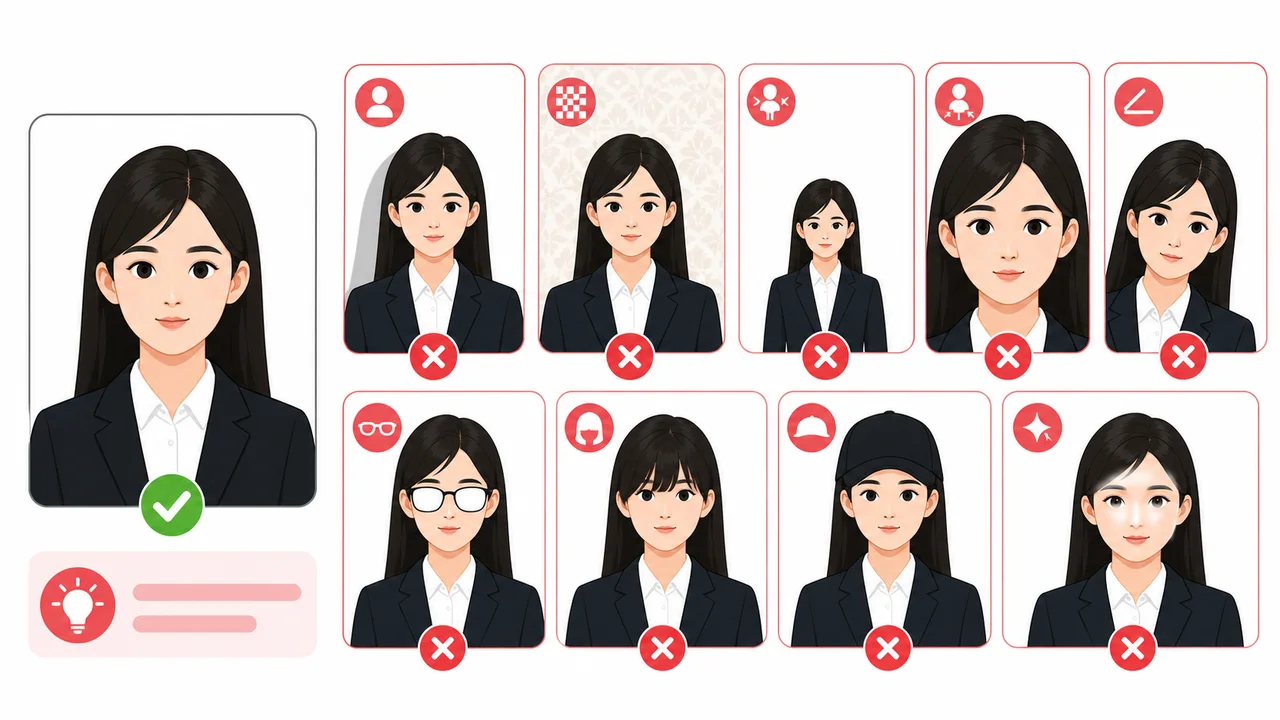
Quick answer
- Uneven lighting or standing too close to the wall can create shadows. Ensure soft, even lighting with no shadows on the face or behind the head.
- Glasses are not prohibited, but removing them is strongly recommended. Thick frames, dark lenses, glare, and frames that cover the eyes often lead to rejection.
- Your head must take up between 60% and 75% of the photo height. Tilting the head is also not allowed.
- It is safest to keep your forehead, eyebrows, and ears clearly visible. Official guidance from some embassies states that ears should be visible. Avoid letting hair cover your eyes, eyebrows, or the contours of your face.
Common China visa photo mistakes
A China visa photo can be rejected even when the outer size looks correct. Shadows, patterned backgrounds, tilted faces, glasses glare, hair covering the eyes or face outline, heavy beautification, and wrong digital file settings all make identity confirmation harder.
For both print and upload, return to the basics: natural face, plain background, clear eyes, correct crop, and a file format that matches the application route.
- Shadow or pattern in the background
- Face tilted or off-center
- Glasses reflection or thick frames
- Hair covering eyes, brows, or face contour
- Beauty filters, enlarged eyes, mirroring, or heavy edits
- Wrong COVA pixel size or file size
When in doubt, retake rather than over-edit
Trying to fix a weak photo can create unnatural edges and compression artifacts. If the image already looks questionable, retaking it in better light is often faster and safer.
Official Source Note
Check the COVA upload screen and the embassy, consulate, or visa center instructions for your actual application route.
This website and application are not affiliated with, sponsored by, or endorsed by COVA, the Ministry of Foreign Affairs of China, any Chinese embassy or consulate, or any visa application center. They do not submit visa applications or guarantee acceptance. Please check the latest official requirements before submitting your application.
Common Mistakes (Reasons for Rejection)
Many visa photo submissions are rejected due to simple errors. Avoid these common mistakes:
Uneven lighting or standing too close to the wall can create shadows. Ensure soft, even lighting with no shadows on the face or behind the head.
Glasses are not prohibited, but removing them is strongly recommended. Thick frames, dark lenses, glare, and frames that cover the eyes often lead to rejection.
Your head must take up between 60% and 75% of the photo height. Tilting the head is also not allowed.
It is safest to keep your forehead, eyebrows, and ears clearly visible. Official guidance from some embassies states that ears should be visible. Avoid letting hair cover your eyes, eyebrows, or the contours of your face.
Avoid white or very light clothing because it can blend into the white background. Darker clothing provides clearer separation.
The COVA digital upload requires a JPEG between 40 KB–120 KB at 354 × 472 px. An incorrect file size or resolution will fail upload validation.
How the App Helps You Prepare Your Photo
Align your face with the official guide lines to easily meet the strict height and width specifications.
Check whether the background is plain white or near-white, with no shadows. It is safest to take the photo in front of a white wall from the start. If you use a background cleanup feature, use it carefully and verify the final image looks natural.
Export a 354 × 472 px JPEG between 40 KB–120 KB, formatted for COVA-style digital upload requirements. Final acceptance depends on the COVA upload check, visa center, embassy or consulate.
All image adjustments are processed entirely on your device. Your photos are never sent to a server.
Note: shoumei.org is an independent photo formatting tool to assist in preparation. It is not affiliated with COVA, the Ministry of Foreign Affairs of China, any Chinese embassy or consulate, or any visa application center. It does not submit visa applications or guarantee acceptance.
Frequently Asked Questions
What are the China visa photo requirements?
A China visa photo must be 33 × 48 mm high for paper submissions, taken within the last 6 months, with the applicant facing forward, no hat, a plain white or near-white background, and a clear image with no shadows. Head height should be 28–33 mm, head width 15–22 mm.
Can I wear glasses?
Glasses are not prohibited, but removing them is strongly recommended. If worn: thin frames only, no dark lenses, no glare, frames must not cover or overlap the eyes. Eyes must be clearly visible.
Should my ears and eyebrows be visible?
Yes, it is safest to keep your forehead, eyebrows, and ears clearly visible. Some official guidance states ears should be visible, so tuck long hair behind your ears. Avoid hair covering the eyes, eyebrows, or the contours of your face.
What are common reasons a China visa photo may be rejected?
Background shadows, hair covering the eyebrows or eyes, glasses with thick frames or glare, white clothing blending into the background, incorrect head dimensions, file size outside 40–120KB, or a photo older than 6 months.
Official Source Note
- COVA - China Online Visa Application photo upload Checked: 2026-06-29
- VisaForChina - Photo requirements FAQ Checked: 2026-09-03
- Consulate-General of China in Los Angeles - Photo Requirements Checked: 2026-06-29
This website and application are not affiliated with, sponsored by, or endorsed by COVA, the Ministry of Foreign Affairs of China, any Chinese embassy or consulate, or any visa application center. They do not submit visa applications or guarantee acceptance. Please check the latest official requirements before submitting your application.
All guides
Create your photo in the browser
Prepare the photo for China Visa directly in your smartphone or computer browser. Creating and reviewing are free.
What this tool creates
- the required face photo (for digital upload)
Prepare Your China Visa Photo Now Download on the App Store